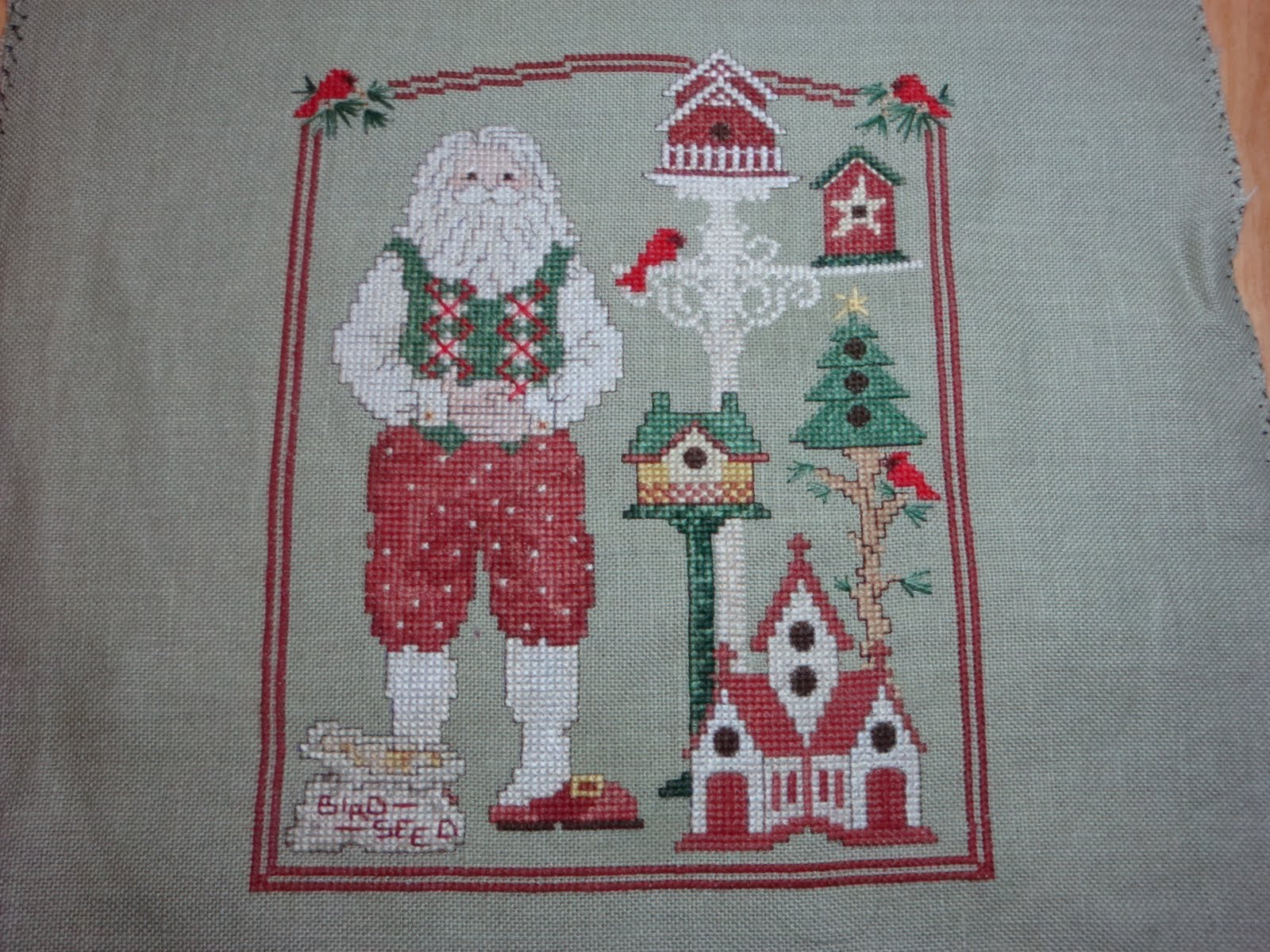
As I mentioned in an earlier post, I have been concentrating on Workbasket's Quaker Sampler so that I might have at least one more finish by year's end. The problem is the smaller motifs aren't really that much smaller than the large ones. And the large ones typically took me a week to stitch. Plus, I am having a harder and harder time making time for stitching lately. I want to do it all: read several books, keep up my blogs, do some NY Times Sunday crossword puzzles [from the huge book I keep by my bed], clean for Christmas, keep up with the routine laundry/dishes/cooking/shopping, watch an episode or two of Babylon 5 [my latest sci-fi marathon], work, and stitch. In any case, I have been working on one of the smaller yellow motif since Sunday and am still not quite done. I'll post a photo when I am.
I have been following a thread on the 123stitch Message Board about people who haven't had a single finish this year. Most of them are, of course, BAP stitchers; some of them are multiple-BAP-in-rotation stitchers. But some seem to be your everyday stitchers who seem to have run out of stitching time or who have slowed to a barely discernible crawl when stitching. I have a feeling this may be my future in stitching. Five years ago I averaged about 60 finishes a year: quite a few smalls, to be sure, but a respectable number of medium and large projects as well as the occasional BAP. This year I'll have either 29 or 30 finishes depending on my progress on the above-mentioned Quaker Sampler. There are still a fair number of smalls and a goodly number of medium projects and even a few BAPs. But the total number has been decreasing steadily for the past few years. I am not conscious of stitching that much less so I must be stitching more slowly. I have been tackling more complex projects, so clearly that slows me down some. But I think it is age, cataracts and the occasional twinge of arthritis that really accounts for the ever decreasing productivity. It just takes me longer to accomplish any given task than it used to do! Aging just isn't as much fun as AARP would have you believe!
I mentioned that I considered the Quaker Sampler a BAP on a recent post and Nikki of Stitch Bitch commented that she had never heard a formal definition of a BAP. So I thought I would query my readers as to what they thought qualifies a piece for the BAP sobriquet. I have isolated a number of elements I think contribute to BAP-ness and I would like you to rate them in order of importance to your understanding of BAPs. I have noted them in my own order of descending importance.
---Sheer Size. What do you think are the lower limits to this element? 14" square, 16" square, 18" square, on up to 24" square and beyond or rectangles with legs that are 14", 16" or 24" or larger?
---Complexity of Design. For instance, a piece with a lot of symmetrical stitching that requires impeccable counting. Or maybe a piece with a fabulously elaborate border involving designs straight out of an illuminated manuscript [like Teresa Wentzler borders]. Areas that, though densely stitched, are really an amalgam of many, many, many confetti stitches [again a Teresa Wentzler trademark]. Or maybe a piece with complex repeats that occasionally switch to irregular repeats, in unpredictable fashion ... as happens in many primitive designs.
---Technical Difficulty. I am borrowing a phrase from Olympic figure skating here but I bet you know what I mean: Queen stitches, Rhodes stitches, Blackwork, Reversible Stitching, Elaborate Beadwork, etc. Also quarter and three quarter stitches, blended needles, endless back-stitching. Certainly Hardangar and Cutwork would qualify, as well.
---Stitching Density. Very little negative space, with stitching covering just about every thread of the linen.
---Challenging Materials. Extensive use of blending filament, delicate specialty fibers, faux furs and other frustratingly breakable flosses. Or rayon floss with its hideous slipperiness that resists proper laying.
Those are the elements I think make up a BAP ... and I think the size can decrease in direct proportion to increases in all the other elements ... and still qualify a piece as a BAP. Can you think of other elements that make a project worthy of the name BAP? How would you rate the importance of each element? Would your order be different from mine? I haven't included elaborate finishing techniques in my list because I think that is a whole other issue. But would you include finishing?




 And, from last year's JCS Christmas preview issue, La-D-Da's Christmas Fleur de Lys. Just below it you can see a Caron Complimentary design stitched on needlepoint canvas.
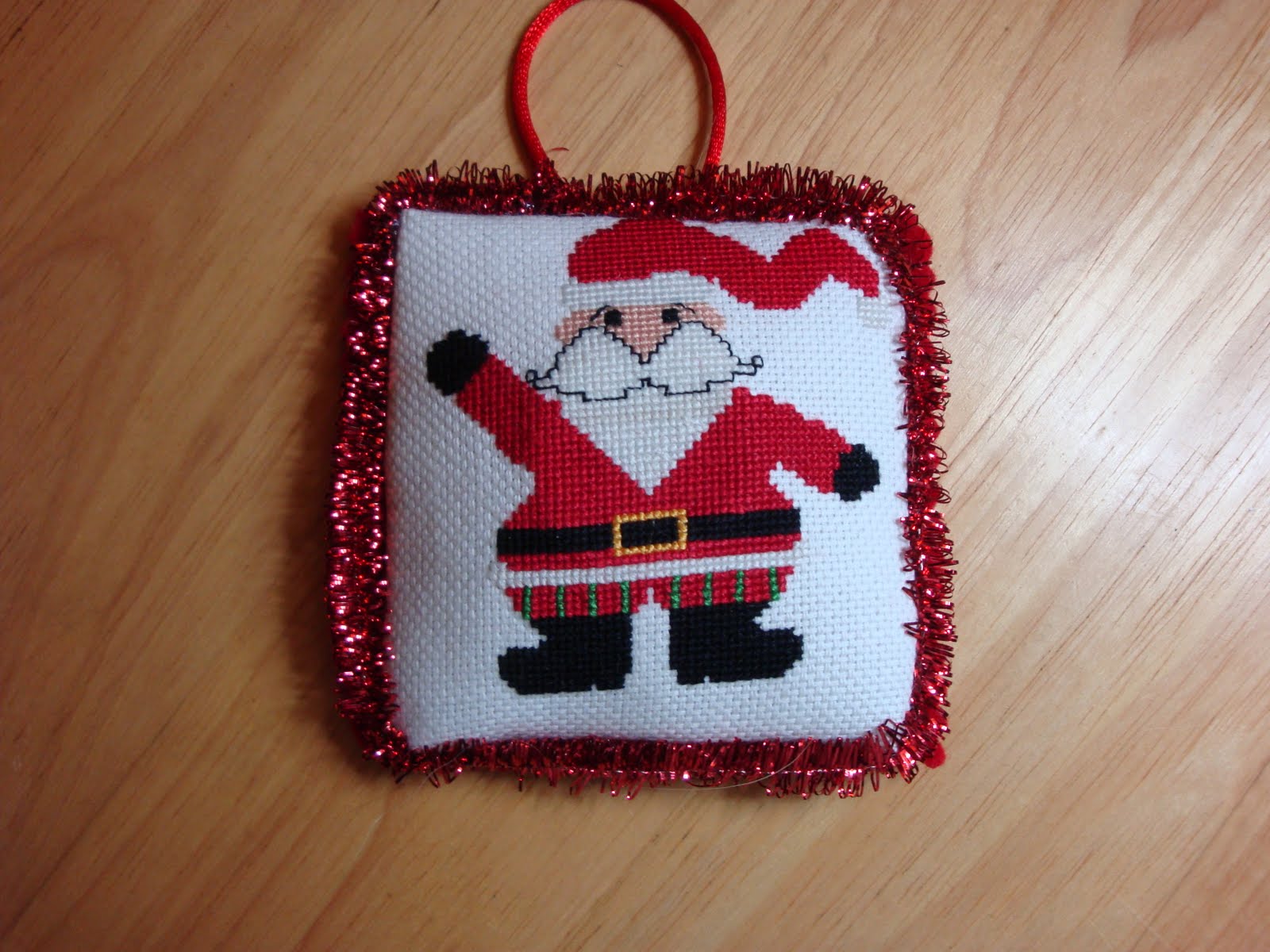
 And a very old Leisure Arts ornament from the 90's, the stitched date notwithstanding.
 And a Heartstrings Artist series Santa ornament, not my best finishing effort but I like it anyway.
 And another Prairie Schooler Promo Card, this time of a Christmas Tree.